Welcome
Welcome to the webpage of PhyND research group!
We are part of the Department of Physics of Politecnico di Milano, and we are located at PoliFab, the micro-nanofabrication center of PoliMi.
We develop and use advanced methodologies for tailoring the physical properties of condensed matter systems, with precision down to the nanoscopic scale.
Our research aims to realize and study new artificial nanostructured materials and devices where to harness complex phenomena and give rise to enhanced functionalities.
News & Highlights
- Invited talk by Edoardo at META 26, Dublin
 Edoardo delivered an invited talk titled “Phase nanoengineering of complex oxides for spin-wave devices” at the 16th International Conference on Metamaterials, Photonic Crystals and Plasmonics (META2026) held in Dublin, Ireland
 - Matteo Vitali talked about 3D patterning at 3DMAG 2026, Wien
 Matteo V gave a talk about 3D nanoscale control of magnetism in crystalline YIG at the 1st International Symposium on Three-Dimensional Nanomagnetism (3DMAG 2026), held in Wien.
 - New Paper on Nanoscale Tuning of Superconductivity in YBCO
 In our new paper on Advanced Functional Materials “Nanoscale Spatial Tuning of Superconductivity in CuprateThin Films via Direct Laser Writing” (https://doi.org/10.1002/adfm.77288), we demonstrated a direct laser writing approach for the nanoscale engineering of the superconducting properties in YBCO thin films. Our approach enables the direct fabrication of superconducting nanostructures with tailored functionalities, opening new opportunities for nanoscale superconducting devices and […]
 - Matteo Panzeri graduated!
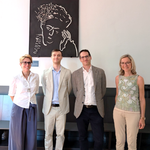 Matteo Panzeri is officially a PhD in Physics! 👨🎓📜 Thesis: Tailoring Magnetic Energy Landscapes for Reconfigurable Chiral Textures and Moiré Superstructures via Direct Laser Writing. Congrats Matteo!!
 - Edoardo gave an invited talk at the Workshop on magnetism for RF applications, MunichEdoardo delivered an invited talk on “Programmable Integrated Magnonic Meshes” at the Microscopic Magnetic Systems for RF Applications workshop in Munich, Germany, hosted at TUM by Markus Becherer and co-organized by Philipp Pirro.
- Daniela gave two invited talks at ICSM 2026, Fethiye
 Daniela gave two invited talks at the 11th International Conference on Superconductivity and Magnetism (ICSM2026) in Fethiye, Turkey: “3D nanoscale control of magnetism in crystalline Yttrium Iron Garnet via direct laser writing” and ” Large-scale direct-write nanoscale control of High-TC superconductivity and magnetism via phase nanoengineering”
 - Arianna and Riccardo at the Zurich Nanofabrication Days 2026, Zurich
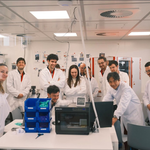 Arianna and Riccardo presented two posters: Magnetic Nanopatterning via Direct Laser Writing: a technique for Reprogrammable Energy Landscapes and Moiré Spin-Texture Lattices and Direct Laser Writing enables Nanoscale Spatial Tuning of Superconductivity in YBa2Cu3O7-δ Thin Films.
 - PhyND group at Magnet 2026, Lecce
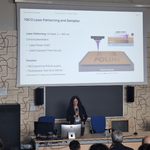 Matteo V. and Irene gave two talks about Three-dimensional Nanoscale Control of Magnetism in Crystalline YIG and Spatial Tuning of Superconducting and Magnetic Properties of YBa2Cu3O7-δ via direct laser writing. Piero and Arianna presented two posters: Magnetic Nanopatterning of Reprogrammable Energy Landscapes and Moiré Spin-Texture Lattices via Direct Laser Writing and Tr-MOKE Imaging of Spin-Wave interactions with Direct-Laser Written YIG […]
 - Edoardo gave a keynote at NanoFab NYC 2025, New York
 Edoardo delivered an invited keynote talk titled “Three-dimensional grayscale control of magnetism and superconductivity via phase nanoengineering” at the Advancements in Nanofabrication for Bio and Quantum Symposium (NanoFab NYC 2025) in New York, US! 🏙️🔬
 - Edoardo gave an invited talk on 3D spin waves at MMM 2025, Palm Beach
 Edoardo delivered an invited talk titled “Three-dimensional Control and Imaging of Spin Waves in Nanostructured Thin Films” at the 70th Annual Conference on Magnetism and Magnetic Materials (MMM 2025) in Palm Beach, US.
 - New Paper on 3D nanostructuring of YIG via laser writing
 In our new paper on Nature Communications “Three-dimensional nanoscale control of magnetism in crystalline Yttrium Iron Garnet” (https://doi.org/10.1038/s41467-025-64630-5), we demonstrated the capabilities of the direct laser writing approach for controlling the magnetic properties of a 1µm-thick, single crystal YIG. The technique allows for a single-step, local enhancement of the perpendicular magnetic anisotropy, which allows for the control of the spin-wave […]
 - Valerio Levati graduated!
 PhD defense done! 🎓 Valerio Levati is officially a PhD in Physics! 👨🎓📜 Thesis: Phase Nanoengineering via Direct Laser Writing for Functional Oxide Thin Films. Congrats Valerio!!🥳🎉
 - Mini-workshop on Quantum & Magnetic Materials NanostructuresWe hosted a mini-workshop on Quantum & Magnetic Materials Nanostructures ! 🔬💡 We were delighted to hear from Amalio Fernández-Pacheco (TU Wien) 🧲 and Anna Palau (ICMAB-CSIC, Barcelona) 🔬.
Research activities
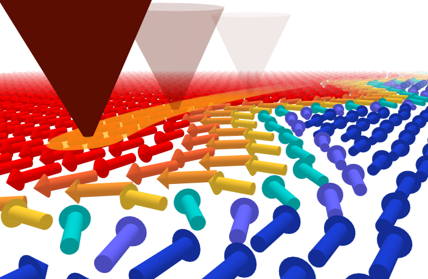
Tools for controlling physics at the nanoscale are crucial for the development of new paradigms in optics, electronics and spintronics. We develop advanced techniques based on thermal scanning probe lithography (t-SPL) and direct laser writing, for crafting the physical properties of materials via physical, structural or chemical modifications.
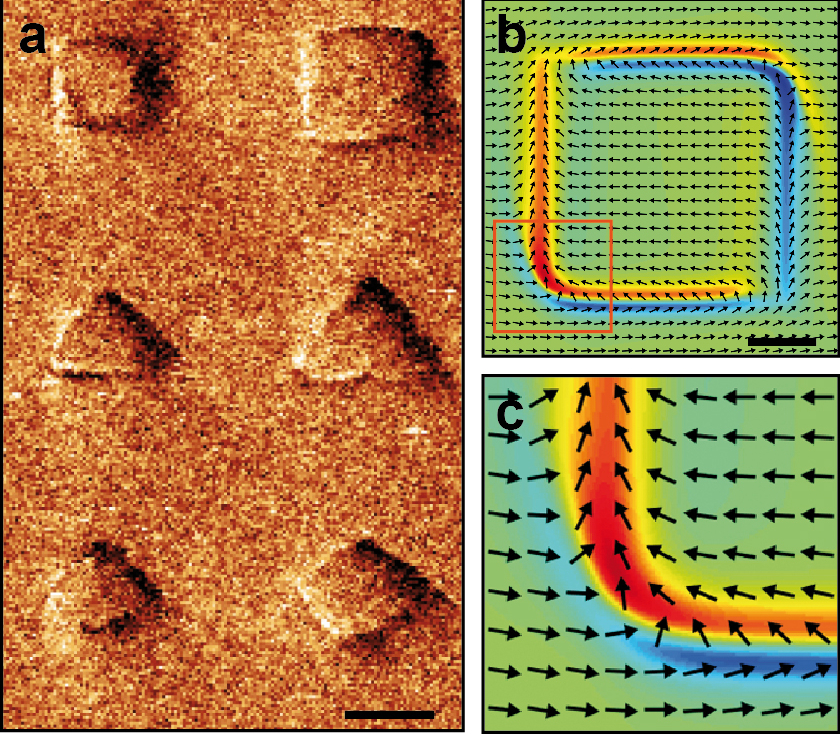
We develop and use thermally assisted magnetic nanopatterning and laser lithography, in combination with nanolithography, for patterning multidimensional spin-textures in magnetic multilayers, such as domains, domain walls and topological solitons. Then, we use such spin textures for controlling and study the emission and propagation of spin waves in magnetic thin films. We study the three-dimensional propagation of spin waves in multilayers
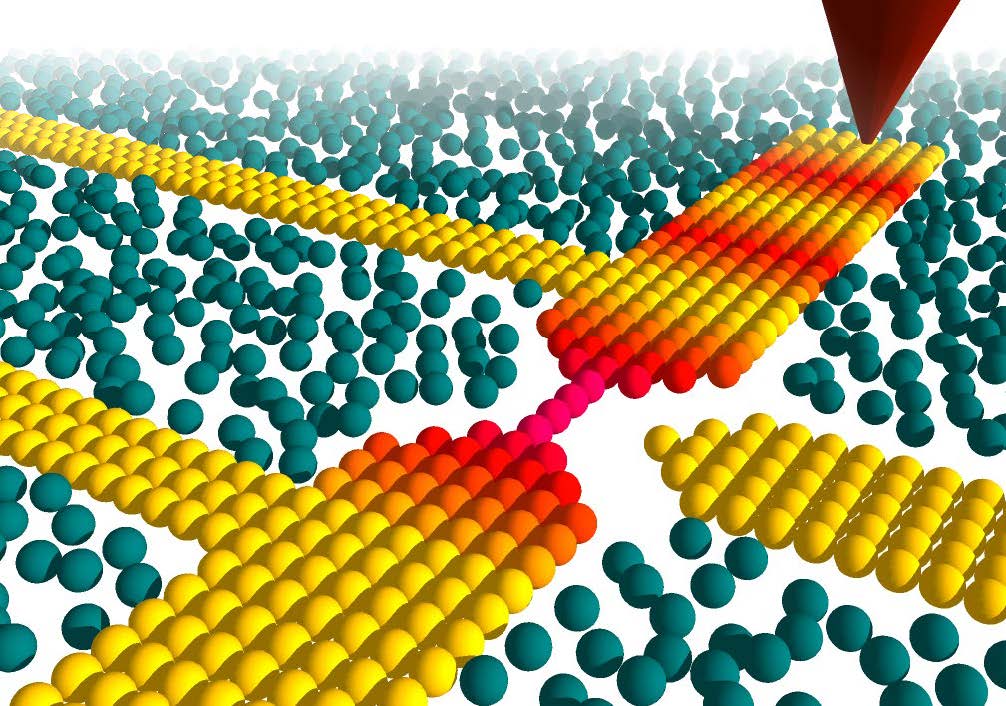
We control at the nanoscale the electronic and spin transport properties of thin-films in phase-change materials and complex oxides, and develop new artificial nanomaterials and devices with engineered electronic transport properties, arising from the proximity and coexistence of different structural and electronic phases.
Publications Highlights
Here you find a list of highlighted recent publications. Links to the full list of our publications on book contributions, patents and the cover page gallery.
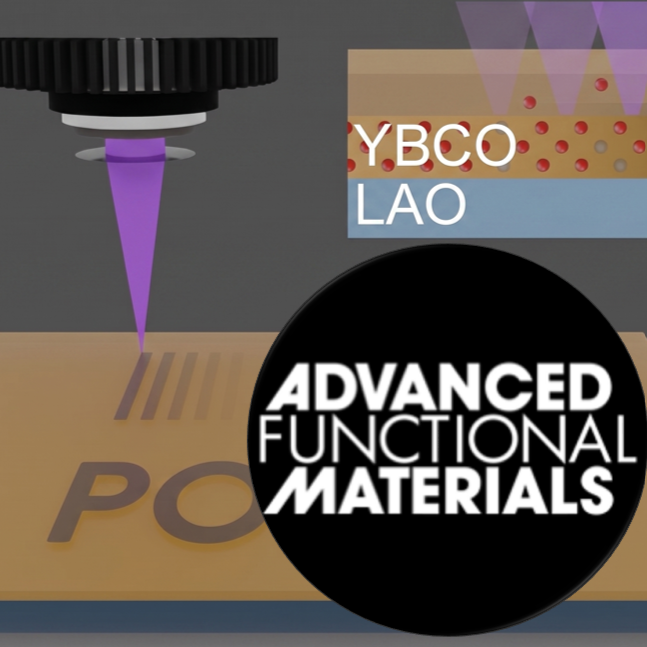
Nanoscale spatial tuning of superconductivity in cuprate thin films via direct laser writing
I. Biancardi et al. Advanced Functional Materials (2026).
We demonstrated a direct laser writing approach for the nanoscale engineering of the superconducting properties in YBCO thin films. Our approach enables the direct fabrication of superconducting nanostructures with tailored functionalities, opening new opportunities for nanoscale superconducting devices and for the investigation of fundamental phenomena in complex oxides.
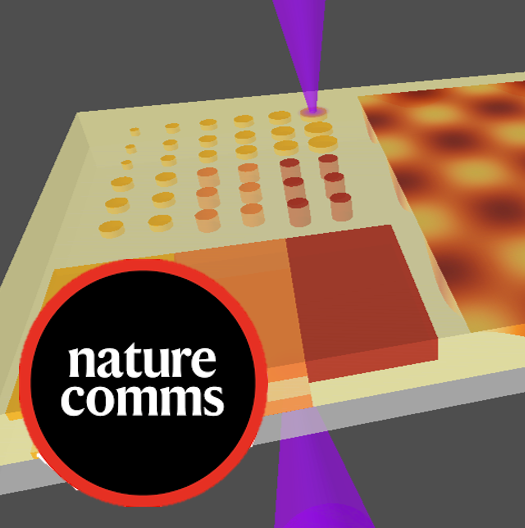
Three-dimensional nanoscale control of magnetism in crystalline Yttrium Iron Garnet
V. Levati, M. Vitali et al. Nature Communications (2025).
We demonstrate a non-destructive method for writing three-dimensional magnetic patterns in crystalline Yttrium Iron Garnet (YIG) films using focused UV laser irradiation to locally enhance perpendicular magnetic anisotropy. This technique enables the precise fabrication of 3D magnonic crystals with tunable spin-wave properties, paving the way for advanced architectures in magnonic and magneto-optic devices.
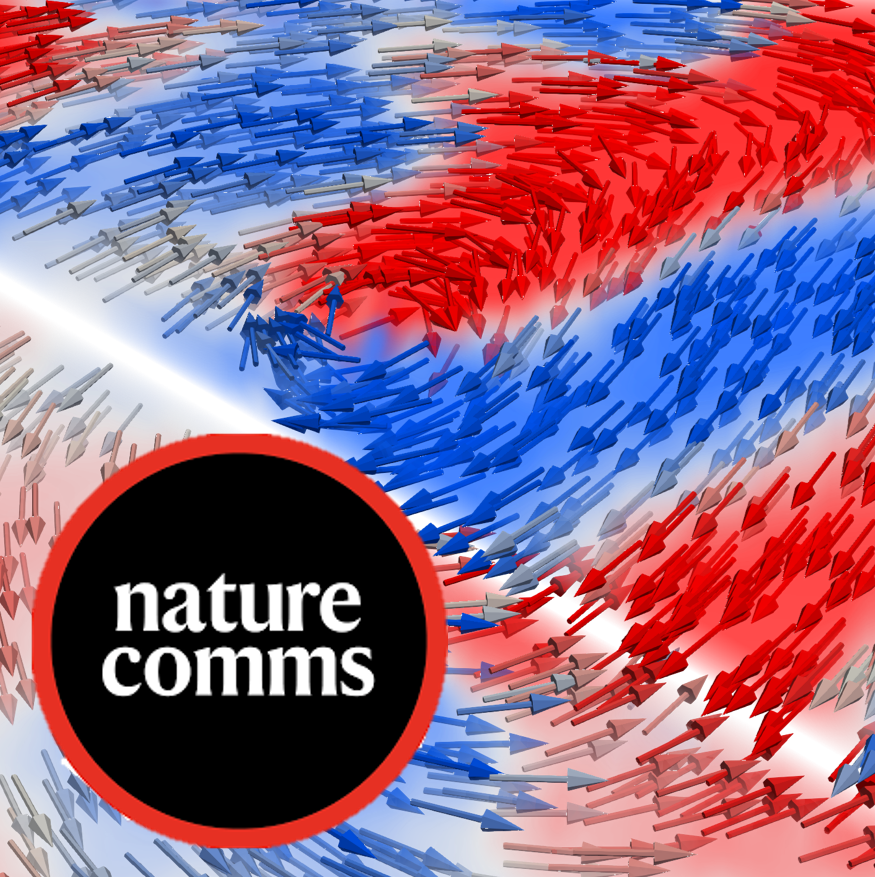
Three-dimensional spin-wave dynamics, localization and interference in a synthetic antiferromagnet
D. Girardi et al. Nature Communications (2024).
We use X-Ray Microscopy Imaging for acquiring time-resolved snapshots of the spin dynamics in a synthetic antiferromagnet, with nanoscale spatial resolution and sub-nanosecond temporal resolution. This allowedus to retrieve the full three-dimensional structure of the spin-wave modes, revealing previously inaccessible features on their anatomy, propagation and interaction within the volume of the material.
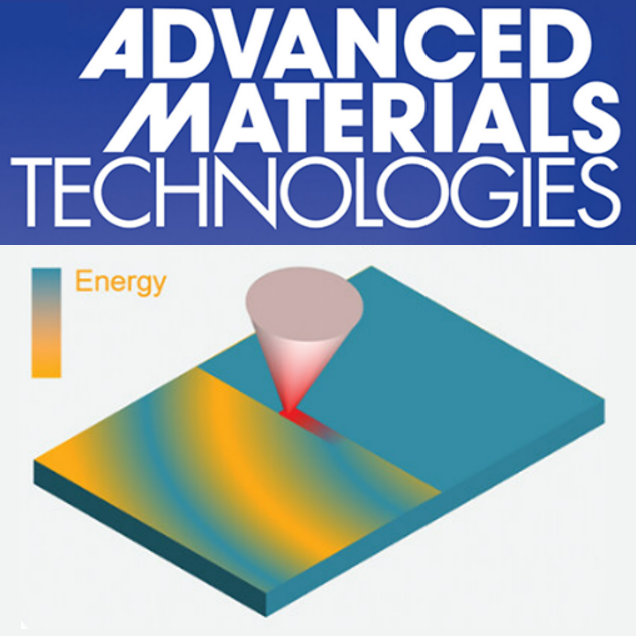
Phase Nanoengineering via Thermal Scanning Probe Lithography and Direct Laser Writing
V. Levati et al. Advanced Materials Technologies (2023).
A perspective on Phase Nanoengineering. Nanomaterials and devices are created using advanced nanofabrication techniques to directly nanostructure condensed matter systems, by inducing highly controlled, localized, and stable changes in the electronic, magnetic, or optical properties.
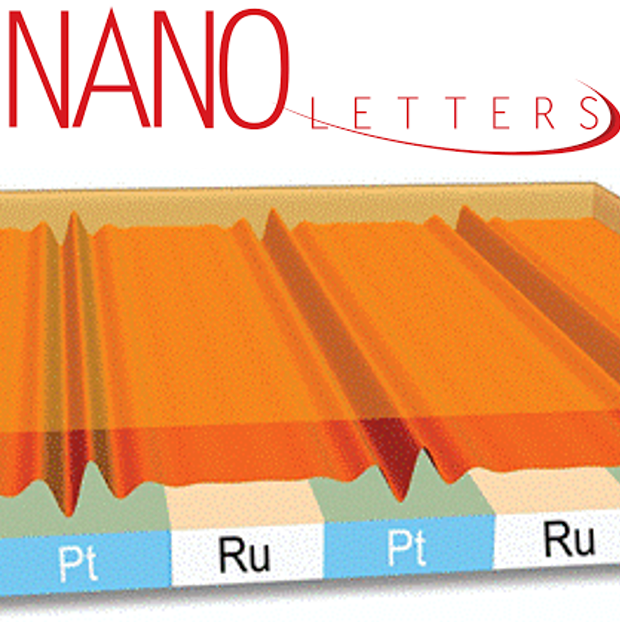
Experimental Observation of Flat Bands in One-Dimensional Chiral Magnonic Crystals
S. Tacchi et al. Nano Letters (2023).
We study the band diagram of a chiral magnonic crystal consisting of a ferromagnetic film incorporating a periodic Dzyaloshinskii–Moriya coupling via interfacial contact with an array of heavy-metal nanowires. We provide experimental evidence for a strong asymmetry of the spin-wave amplitude and nonreciprocal propagation.
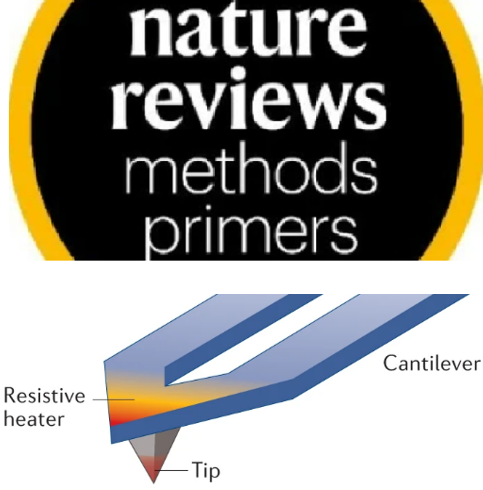
Thermal scanning probe lithography
E. Albisetti et al. Nature Reviews Methods Primers 2, 32 (2022).
We describe the working principles of Thermal scanning probe lithography (tSPL) and highlight the characteristics that make it a powerful tool to locally and directly modify material properties. We cover the applications of tSPL in biomedicine, nanomagnetism and nanoelectronics, and give an outlook on future developments.
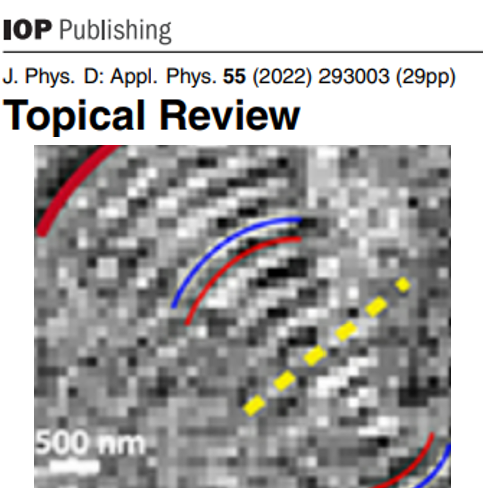
Review on magnonics with engineered spin textures
D. Petti et al. Journal of Physics D: Applied Physics, 55, 293003 (2022).
Spin textures, such as non-uniform domain arrangements, domain walls and skyrmions are naturally occurring structures in magnetic materials. In this review, we focus on the recent developments on the control and stabilization of engineered spin textures, and their applications in the field of magnonics.
The 2021 Magnonics Roadmap
A. Barman et al. Journal of Physics: Condensed Matter, 33, 413001 (2021).
Magnonics is a budding research field in nanomagnetism and nanoscience that addresses the use of spin waves (magnons) to transmit, store, and process information. This is a collection of 22 sections written by leading experts in this field who review and discuss the current status besides presenting their vision of future perspectives.
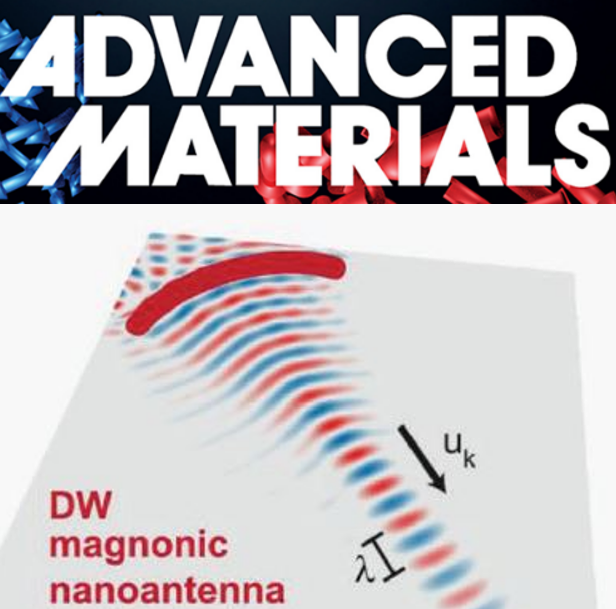
Optically Inspired Nanomagnonics with Nonreciprocal Spin Waves in Synthetic Antiferromagnets
E. Albisetti et al. Advanced Materials, 32, 1906439 (2020).
An optically inspired platform using spin waves is realized, demonstrating the wavefront engineering, focusing, and robust interference of spin waves with nanoscale wavelength. Magnonic nanoantennas based on spin textures are used for launching spatially shaped coherent wavefronts, and generating robust multi-beam interference patterns.
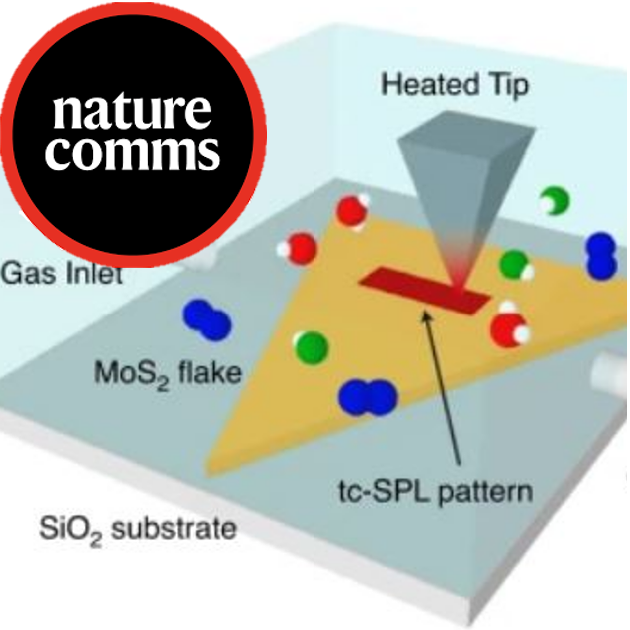
Spatial defects nanoengineering for bipolar conductivity in MoS2
X. Zheng et al. Nature Communications, 11, 1–12 (2020).
We demonstrate the integration of thermochemical scanning probe lithography (tc-SPL) with a flow-through reactive gas cell to achieve nanoscale control of defects in monolayer MoS2. The tc-SPL produced defects can present either p- or n-type doping on demand, allowing the realization of field effect transistors, and p-n junctions
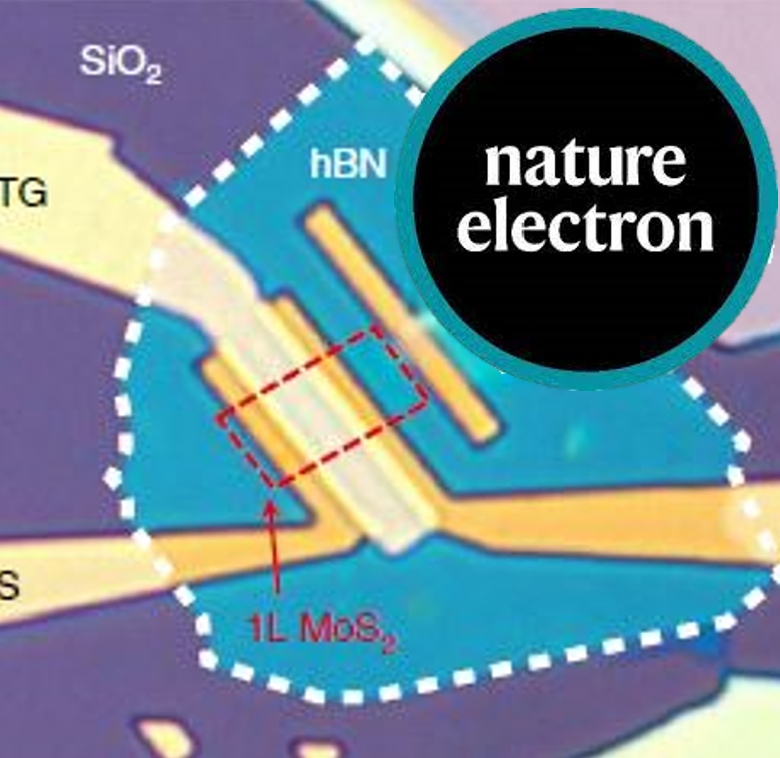
Direct metal contacts on MoS2 with vanishing Schottky barrier via thermal nanolithography
X. Zheng et al. Nature Electronics, 2, 17–25 (2019).
We show that thermal scanning probe lithography can be used to pattern metal electrodes with high reproducibility, sub-10-nm resolution, and high throughput (105 μm2 h−1 per single probe). We pattern metal electrodes in contact with monolayer MoS2 realizing high-quality top-gate and back-gate field-effect transistors.
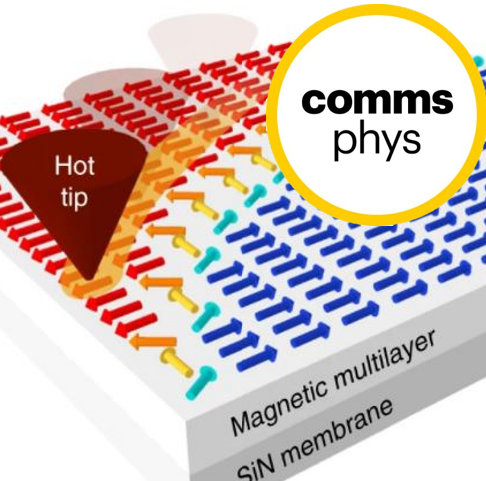
Nanoscale spin-wave circuits based on engineered reconfigurable spin-textures
E. Albisetti et al. Communications Physics, 1, 56 (2018).
We realize a nanoscale reconfigurable spin-wave circuitry by using patterned spin textures. We directly visualize the channeling and steering of propagating spin waves in arbitrarily shaped nanomagnonic waveguides and we demonstrate a prototypic circuit allowing for the tunable interference of confined spin-waves modes.
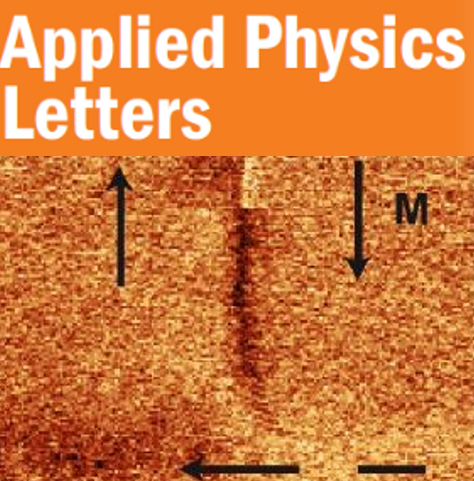
Stabilization and control of topological magnetic solitons via magnetic nanopatterning of exchange bias systems
E. Albisetti et al. Applied Physics Letters 113,162401 (2018).
We show the non-volatile creation of vortex-antivortex pairs in an exchange bias bilayer by tailoring vectorially the unidirectional anisotropy at the nanoscale, via thermally assisted magnetic scanning probe lithography. We demonstrate the stabilization of cross and circular Bloch lines within patterned Néel magnetic domain walls.
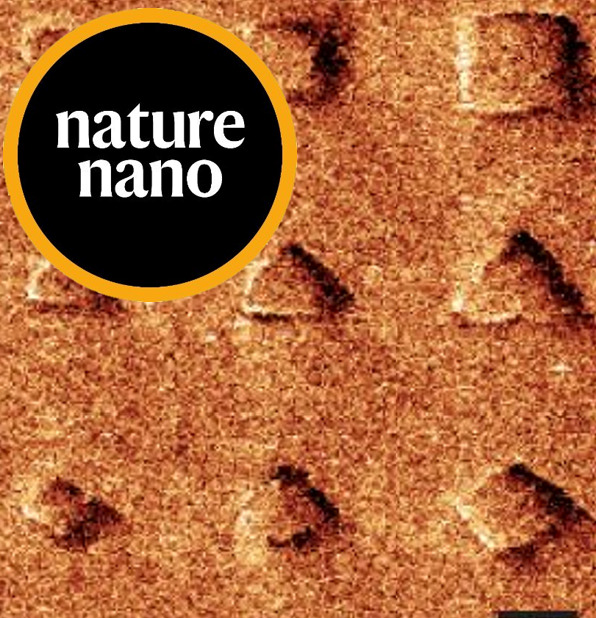
Nanopatterning reconfigurable magnetic landscapes via thermally assisted scanning probe lithography
E. Albisetti et al. Nature Nanotechnology, 11 (6), 545–551 (2016).
We create reconfigurable magnetic nanopatterns by crafting, at the nanoscale, the magnetic anisotropy landscape of an exchange-biased ferromagnetic film. By scanning the hot tip of a scanning probe microscope, spin textures are directly and reversibly patterned, and used for controlling the excitation and propagation of spin waves.
Thermochemical scanning probe lithography of protein gradients at the nanoscale
E. Albisetti et al. Nanotechnology, 27, 315302 (2016).
We demonstrate the use of thermochemical scanning probe lithography (tc-SPL) for defining micro- and nano-sized patterns with precisely controlled protein concentration. First, tc-SPL is performed by scanning a hot atomic force microscopy tip on a polymeric substrate, then the substrate is functionalized with streptavidin and laminin proteins.
Projects & Funding
Our research received funding from the following agencies and programmes. Our laboratories receive funding by the European Research Council through ERC Stg Grant number 948225, Project B3YOND. Take a look to our active and past projects.

H2020 Programme





Programme